
Coal production in Europe has been steadily falling since the 1980s and although coal’s importance will continue to decline, the European coal sector remains a key supplier of secure energy, offers well-paid employment and supports long value chains across Europe. In total, the industry employs 144 thousand people in the European Union and a total of 296 thousand people across Europe.
In its proposal for a Just Transition Fund, the European Commission estimated that, “Overall, coal infrastructure is present in 108 European regions and close to 237 000 people are employed in coal-related activities, whereas almost 10 000 people are employed in peat extraction activities and around 6 000 are employed in the oil shale industry.” (European Commission, 2020a, p.1).
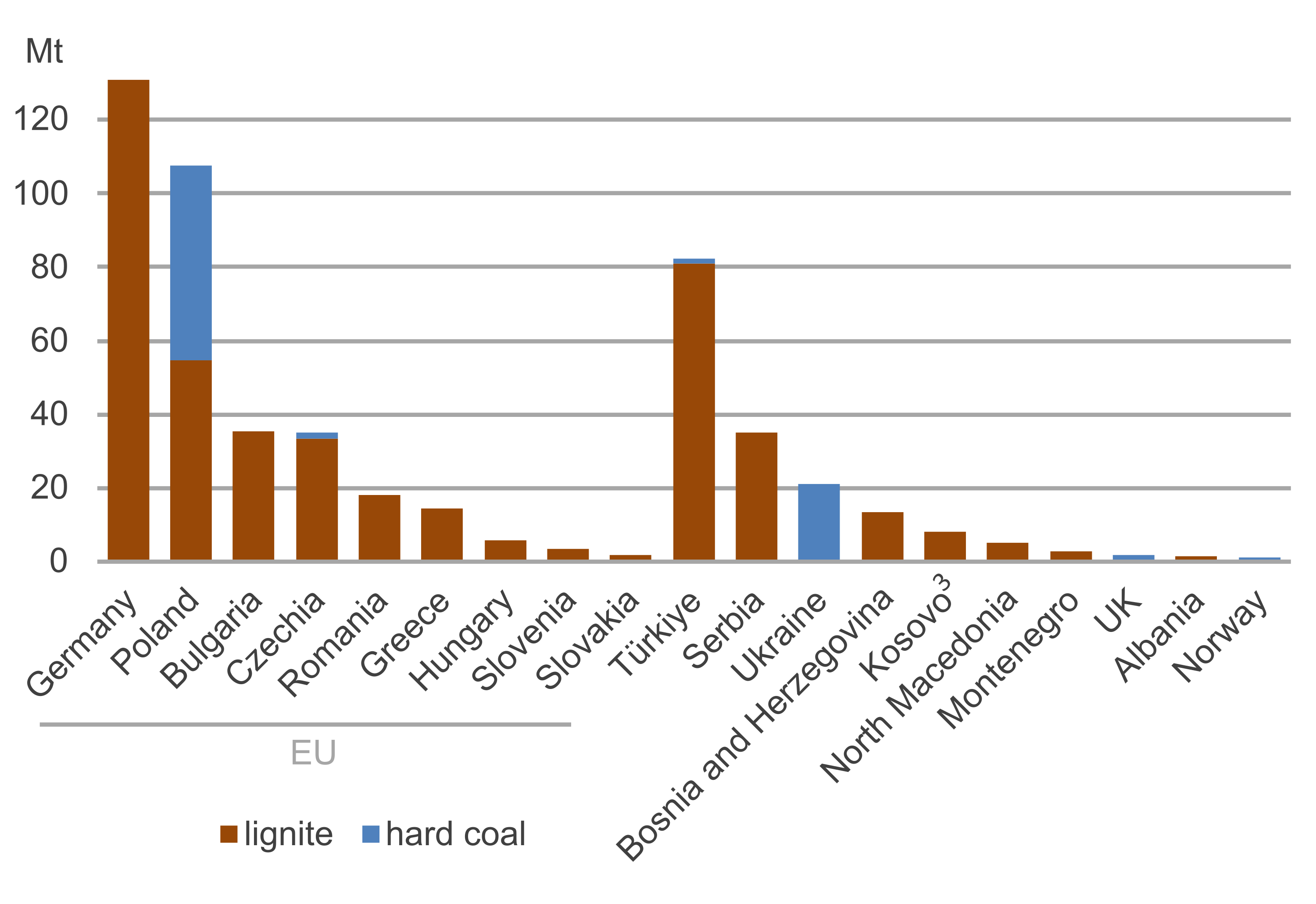
Figure 1 – Coal and lignite production in Europe, 2022 (Sources: EURACOAL members and Eurostat)
Coal: a vital and secure component of EU energy supply
Coal (including lignite) is mined in nine EU member states and ten neighbouring countries (Figure 1). It is mainly used for electricity generation and district heating, but is also important for iron and steel making, and cement production.
Table 1 – Employees in the European coal industry, 2018 and 2022 Sources: EURACOAL members; JRC, 2021; and *estimate
|
2018 |
2022 |
|||||
|
Hard Coal |
Lignite |
Total |
Hard Coal |
Lignite |
Total |
|
|
Albania * |
– |
n.a. |
n.a. |
– |
500 |
500 |
|
Bosnia and Herzegovina |
– |
13 323 |
13 323 |
– |
13 350 |
13 350 |
|
Bulgaria |
– |
10 294 |
10 294 |
– |
11 350 |
11 350 |
|
Czech Republic |
6 757 |
7 147 |
13 904 |
3 299 |
8 247 |
11 546 |
|
Germany |
4 125 |
15 876 |
20 001 |
655 |
17 206 |
17 861 |
|
Greece |
– |
4 082 |
4 082 |
– |
3 723 |
3 723 |
|
Hungary |
– |
1 400 |
1 400 |
51 |
1 300 |
1 351 |
|
Kosovo3 |
– |
4 731 |
4 731 |
– |
3 884 |
3 884 |
|
Montenegro |
– |
921 |
921 |
– |
960 |
960 |
|
North Macedonia |
– |
3 658 |
3 658 |
– |
4 266 |
4 266 |
|
Norway |
126 |
– |
126 |
53 |
– |
53 |
|
Poland |
82 843 |
8 583 |
91 426 |
72 911 |
6 980 |
79 891 |
|
Romania |
3 022 |
13 000 |
16 022 |
2 045 |
12 894 |
14 939 |
|
Serbia |
3 500 |
14 850 |
18 350 |
– |
16 700 |
16 700 |
|
Slovakia |
– |
2 000 |
2 000 |
– |
1 551 |
1 551 |
|
Slovenia |
– |
1 252 |
1 252 |
– |
1 196 |
1 196 |
|
Spain |
1 549 |
– |
1 549 |
261 |
– |
261 |
|
Türkiye |
14 251 |
37 596 |
51 847 |
8 528 |
44 457 |
52 985 |
|
Ukraine |
44 300 |
– |
44 300 |
58 809 |
– |
58 809 |
|
United Kingdom |
647 |
– |
647 |
344 |
– |
344 |
|
Total |
161 120 |
138 713 |
299 833 |
146 956 |
148 564 |
295 520 |
The coal sector plays an important role in terms of energy security with 166 coal-fired power plants operating in eighteen EU countries having a total net capacity of 128 GW in 2022 and generating 481.8 TWh (gross) or 17.1% of EU electricity supply. In the winter of 2021‑22, these plants helped the EU survive the shock of losing Russian gas as previously retired coal plants were brought back into service to replace lost gas-fired generation.

Figure 2 – Coal, lignite, peat and oil shale in EU electricity generation, 2022 (Source: Eurostat nrg_bal_peh database, last updated 19.12.2023)

EU coal use in the global context
As the EU phases out coal and eventually all other fossil fuels, coal use in China continues to expand. Figure 3 shows a comparison of coal use in Europe (including Türkiye) since the industrial revolution and coal use in China which industrialised later. Despite some disruptions caused by global events – two world wars and the oil shocks of the 1970s – European coal use has followed an otherwise perfect, bell-shaped Hubbert curve for the production of a finite resource exploited in a free-market economy. Europe is now at the tail end of that curve. China, on the other hand, has only relatively recently begun to exploit its vast coal reserves at scale. There has been a remarkable expansion of coal mining since 2001 when China joined the World Trade Organization. Since then, its industrial output has grown quickly, requiring more and more energy and resources.

Figure 3 – European and Chinese coal production, 1800 to 2100 (Sources: IEA, 2009, Annex I; IEA databases; and Rutledge, 2011)
Carbon leakage through consumption
As EU consumers benefit from a great variety of imported products, “carbon leakage” must be addressed. The carbon footprint of EU consumption extends around the world. It is legitimate to ask, for example, why jobs are under threat because of EU climate policy when citizens rely so heavily on products from China where production depends on coal: 64% of electricity generation and 56% of plastics production. In response, it could be said that China now invests more than any other nation in renewable energy sources and, like Europe, will transition in good time. Moreover, the energy transition in the EU can only proceed because of the availability of affordable products from China: solar PV panels, electronic monitoring and control systems, processed raw materials, electric vehicles and their components, heating and cooling equipment, and even the humble light bulb now based on LED technology.

Energy industry subsidies in the EU
The energy transition to renewable energy sources comes at a cost. According to the 2022 Report on Energy Subsidies in the EU (COM(2022) 642), which draws on a “Study on energy subsidies and other government interventions in the European Union” commissioned from Enerdata and Trionomics by DG Energy, renewable energy subsidies reached €81 billion in 2020, a new record. Two thirds of these subsidies or €54 billion were renewable feed-in tariffs, while feed-in premia and quotas added a further €15 billion. Fossil fuel subsidies, on the other hand, decreased to €50 billion, mostly in the form of much-needed financial support to poorer energy consumers who face hardship. Energy companies are estimated to have received direct subsidies of €13 billion in 2021.

Figure 4 – EU energy subsidies by type of energy, 2015 to 2021 (Source: European Commission, 2022a, Figure 3)
At the same time, fossil fuel companies are subject to significant corporate taxes, royalties, environmental fees, and most importantly the EU ETS which raised €30 billion across the EU member states in 2022 (Figure 6). EU-wide funds – the Innovation Fund and the Modernisation Fund – have redistributed a small part of EU ETS revenues, €6 billion in 2021. With the doubling of the rate of EU ETS allowance removals from 2024 and the introduction of a new trading system from 2028 for buildings, transport and other sectors (ETS 2), government revenues from EU carbon trading alone will exceed all types of fossil fuel subsidies.

Figure 5 – Fossil fuel subsidies by sector in the EU, 2021 (Source: ibid., Figure 6)
Embracing industrial change – a century of coal in transition
As more countries announce coal phase-outs for electricity generation, it is worth noting that this is by no means the first sector to switch away from coal. The UK Royal Navy converted its fleet to oil in the 1910s; from the 1920s and 1930s onwards, diesel-electric trains proved more convenient than steam trains, by the 1950s many countries had electrified mainline railways, since the 1960s North Sea gas replaced coal for heating in a number of Western European countries, and the same gas began to compete with coal for utility-scale power generation in the 1990s. Today, coal is used mainly for heat and power generation, iron and steel making and cement production, so the 2030s and 2040s will likely see some dramatic changes in these industries. While steel producers might gradually turn to “green” hydrogen and the direct reduction of iron ore, a complete switch would require enormous volumes of hydrogen from electrolysers powered by renewable energy sources or nuclear power. Perhaps steel itself will be replaced by a better alternative that does not suffer from corrosion. The cement sector and others are considering alternatives such as carbon capture, use and storage (CCUS) and this maturing technology is likely to become more important as the EU strives for net-zero greenhouse gas (GHG) emissions by 2050.

Figure 6 – EU Emissions Trading System revenues, 2013 to 2022 (Source: EEA, 2023)
 powering transition in Europe