
 Since 2013, Hungary’s export-oriented economy has grown strongly thanks in part to significant corporate investments in the automotive equipment sector. The country enjoys almost full employment; the unemployment rate fell to 3.1% in 2022. Looking ahead, the government plans to boost its stake in “strategically important sectors” while a 2022 decree allows energy companies to be placed under government supervision in times of emergency. Due to its sparse energy and raw material resources, Hungary’s import dependency (54.1% in 2021) is close to the EU average, with oil (86.9% import dependence) and fossil gas (67.2%) accounting for large shares of supply.
|
General data |
|
2022 |
|
Population |
million |
9.6 |
|
GDP |
€ billion |
168.9 |
|
Per capita GDP |
€/person |
17 600 |
Total fossil energy resources in Hungary comprise about 10.7 billion tonnes of coal, 177 billion cubic metres of fossil gas and 18 million tonnes of oil. Lignite and brown coal account for about half of Hungary’s total coal resources and are the most important indigenous sources of energy currently exploited.
Hungary’s total energy supply in 2022 amounted to 36.5 Mtce. Fossil gas had the biggest share in this total (31.0%), followed by oil (30.6%), nuclear energy (15.6%), renewables and waste (13.9%) and coal (4.9%). Around 99% of hard coal is imported – 0.8 million tonnes in 2022. Hungary aims to increase the share of renewable energy in gross final energy consumption to 21% by 2030. In 2022, the share was 13.0%.
National electricity generation in 2022 totalled 35.8 TWh from an installed capacity of 10.6 GW. A net 12.2 TWh of electricity was imported. Nuclear energy from Hungary’s sole nuclear power plant at Paks accounted for 44.2% of gross electricity production in 2022. This state-owned plant has four reactors with a combined gross capacity of 2 000 MW. As a result of a service lifetime extension programme agreed by the Hungarian parliament in December 2022, the four units at Paks will operate for another twenty years. Paks II (2 × 1 200 MW) has been approved for constructed on the same site; a construction licence was granted in August 2022 and the new units 5 and 6 are expected to start operation in 2032. Gas-fired generation also makes a major contribution to national electricity supply with a share of 24.7% in 2022. Electricity produced from coal, mostly lignite, had a share of 8.6% in gross electricity production in 2022, generated mainly by MVM MÁTRA ENERGIA ZRT which state-owned MVM purchased from OPUS GLOBAL in March 2020. Renewable energy sources had a share of 20.9%, mostly solar PV and biomass, followed by industrial and municipal wastes, and some hydro. A renewables support scheme adopted in June 2016, with feed-in tariffs and premiums, led to a surge in solar PV projects.
The second National Climate Change Strategy, approved by the Hungarian parliament in October 2018, targets a 40% reduction in greenhouse gas (GHG) emissions by 2030, compared with 1990, and a 52% to 85% reduction of gross GHG emissions by 2050. In June 2020, Hungary adopted a new law making the net-zero emission target by 2050 a binding obligation. The Ministry for Innovation and Technology (MIT) updated the National Energy Strategy with an outlook to 2040 in which a decarbonised electricity mix will be central to achieving climate targets while strengthening energy independence and security.
In July 2022, the Hungarian government launched a seven-point plan to further enhance energy security: an export ban on certain energy sources, increasing domestic fossil gas and coal production, re-starting the coal-fired Mátra power plant, extending the working hours of the Paks nuclear power plant, purchasing additional fossil gas for storage, and increasing regulated utility prices to better reflect market conditions. A new Ministry of Energy was established in December 2022 with responsibility for energy, environment and climate policies.
Lignite
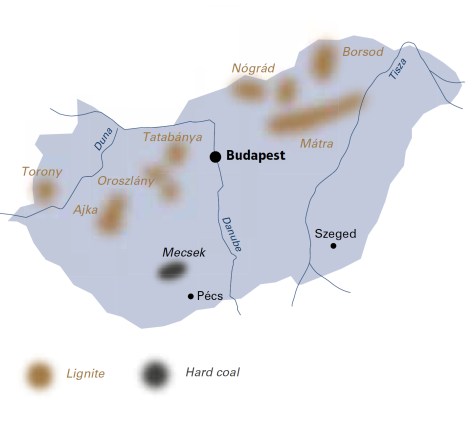
Hungary’s lignite and brown coal resources are concentrated in the Transdanubia region and in Northern Hungary. In 2022, Hungary’s total lignite output was 4.9 million tonnes. Almost all of this was used for heat and power generation, with only small quantities supplied elsewhere, mainly to households.
Since the closure in 2014 of the Márkushegy underground mine in western Hungary, all lignite production has been at surface mines, principally the Visonta and Bükkábrány mines belonging to MVM MÁTRA ENERGIA (MÁTRA). The approved mining fields of these two opencast mines have about 770 million tonnes of lignite reserves.
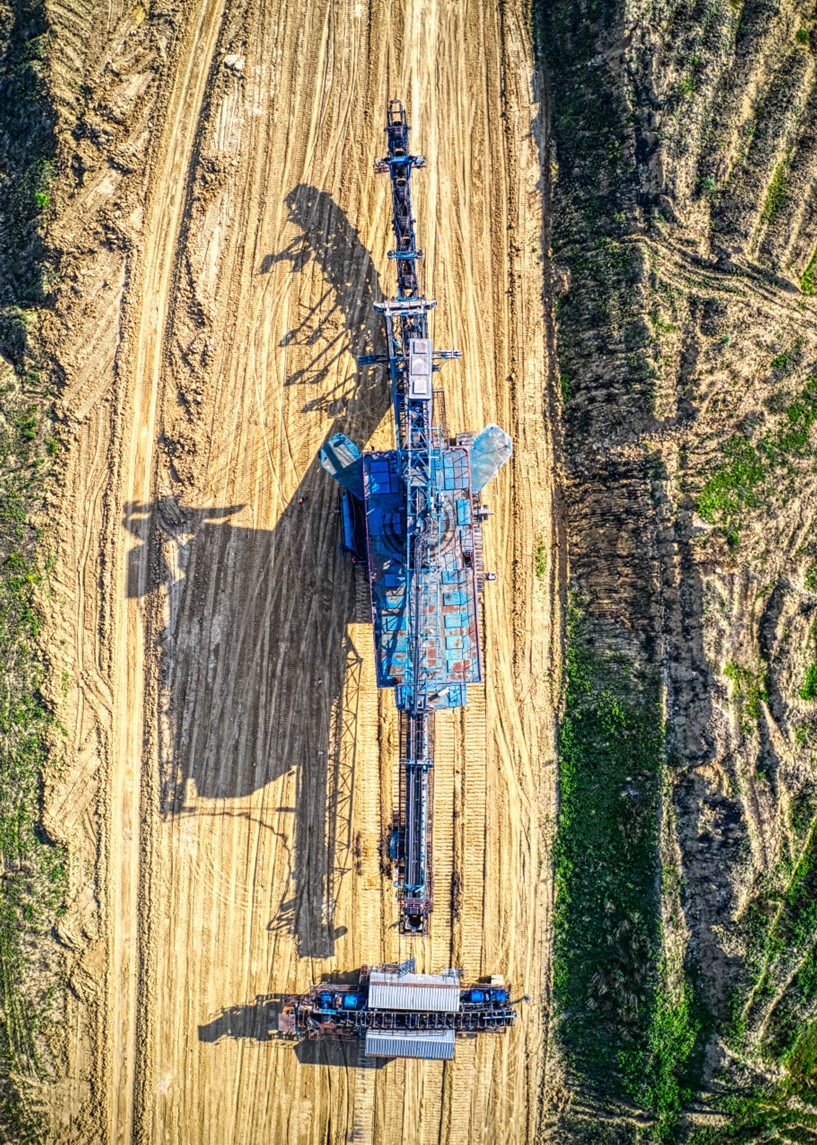
In 2022, MÁTRA produced 4.9 million tonnes of lignite and removed over 30 million cubic metres of overburden – a stripping ratio of 6.1. The lignite is used in the company-owned power plant at Visonta which comprises four lignite-fired units and two topping gas turbines. Lignite from the Bükkábrány mine, some 50 kilometres from the power plant, is transported by rail while a conveyor belt links the plant to the adjacent Visonta mine. Besides lignite and fossil gas, biomass is co‑fired to a fuel input level of around 10%.
The Mátra power plant at Visonta, located 90 kilometres north-east of Budapest, has a total capacity of 950 MW (2 × 100 MW units, 1 × 220 MW unit, 2 × 232 MW units, 2 × 33 MW gas turbines). The wet flue gas desulphurisation (FGD) system commissioned in 2000 is interesting as it is installed inside dry cooling towers and makes use of the natural draft to release flue gas high into the atmosphere. The plant is also fitted with selective, non‑catalytic NOx reduction (SNCR) to further reduce pollutant emissions. Additional wet cooling cells have been added to units 4 and 5 to create a hybrid cooling system that improves efficiency.
As part of its development strategy, MÁTRA has created an industrial park at Visonta with many activities related to the power plant, such as block manufacture using bottom ash and fly ash, plasterboard production using gypsum from the FGD system, biomass fuel processing, a biodiesel/bioethanol plant, and a 16 MW solar PV park.
Looking to the future, in March 2023 MÁTRA issued a call for tenders for a 650 MW gas-fired CCGT. This is just one part of a major transformation of the Visonta site which the government approved in April 2022. MVM will develop two further solar PV parks with a total capacity of 200 MW on reclaimed areas at the lignite mines, and construct a 38‑45 MW power plant fuelled with mixed household waste (RDF) and biomass. Support for this €1 billion investment comes from free allowances granted under Article 10c of the EU ETS Directive as well as from other public sources.
Hard coal
PANNON HŐERŐMŰ ZRT owned by VEOLIA has extracted small quantities of coal from the Pécs-Vasas surface mine in Southern Transdanubia. This coal is officially classified as lignite due to its low calorific value.
Hungary
|
Coal production, reserves and resources |
2022 |
|
|
Hard coal saleable output |
Mt |
– |
|
Hard coal reserves |
Mt |
276 |
|
Hard coal total resources |
Mt |
5 351 |
|
Lignite saleable output |
Mt |
4.9 |
|
Lignite reserves |
Mt |
2 633 |
|
Lignite total resources |
Mt |
5 337 |
|
Saleable coal quality |
|
|
|
Hard coal net calorific value |
kJ/kg |
17 549 |
|
Lignite net calorific value |
kJ/kg |
6 742 |
|
Lignite ash content |
% a.r. |
23.0 |
|
Lignite moisture content |
% a.r. |
47.4 |
|
Lignite sulphur content |
% a.r. |
1.2 |
|
Coal imports / (exports) |
|
2022 |
|
Hard coal |
Mt |
0.8 / (0.0) |
|
Lignite |
Mt |
0.1 / (0.0) |
|
Primary energy production |
|
2022 |
|
Total primary energy production |
Mtce |
15.2 |
|
Hard coal production |
Mt / Mtce |
0.0 / 0.0 |
|
Lignite production |
Mt / Mtce |
4.9 / 0.8 |
|
Primary energy consumption |
|
2022 |
|
Total primary energy supply |
Mtce |
36.5 |
|
Hard coal consumption |
Mt / Mtce |
0.8 / 0.7 |
|
Lignite consumption |
Mt / Mtce |
5.0 / 1.1 |
|
Power supply |
|
2022 |
|
Total gross power generation |
TWh |
35.8 |
|
Net power imports (exports) |
TWh |
12.2 |
|
Total power supply |
TWh |
45.9 |
|
Power generation from lignite |
TWh |
2.9 |
|
Lignite power generation capacity |
MW net |
1 007 |
|
Employment |
|
2022 |
|
Direct in hard coal mining |
number |
51 |
|
Direct in lignite mining |
number |
1 300 |
|
Other lignite-related * |
number |
700 |
* i.e. in power generation at MÁTRA power plant
 powering transition in Europe