
 At the heart of the Balkans, Serbia is well located for services and trade: the Morava Valley is the easiest land route from Europe to Türkiye and beyond. Since 2012, Serbia has been a candidate for EU membership; trade with the EU accounted for 58.8% of the country’s total trade in 2022.
|
General data |
|
2022 |
|
Population |
million |
6.7 |
|
GDP |
€ billion |
60.4 |
|
Per capita GDP |
€/person |
9 100 |
For energy, Serbia relies on lignite and small quantities of imported coal: 43.3% of its total energy supply of 23.0 million tonnes of coal equivalent in 2021. The country’s electricity generation is based on lignite – 62.3% of 38.2 TWh gross generation in 2021 – and hydro (31.3%), recently complemented by wind power (2.8%). Serbia trades electricity with all its neighbours and is often a net importer, 0.7 TWh in 2021 and 2.6 TWh in 2022.
To increase power sector efficiency, the Serbian government has gradually introduced competition since adopting the Energy Law 2004. Opening of the electricity market will continue until it is fully opened in line with the country’s ratification of the Energy Community Treaty in 2006.
According to Serbia’s draft national energy and climate plan, the country will increase the share of renewable energy sources in electricity generation to 49.1% by 2030, requiring 75 GW of new renewables capacity. Serbia also considers nuclear power plants, including small modular reactors.
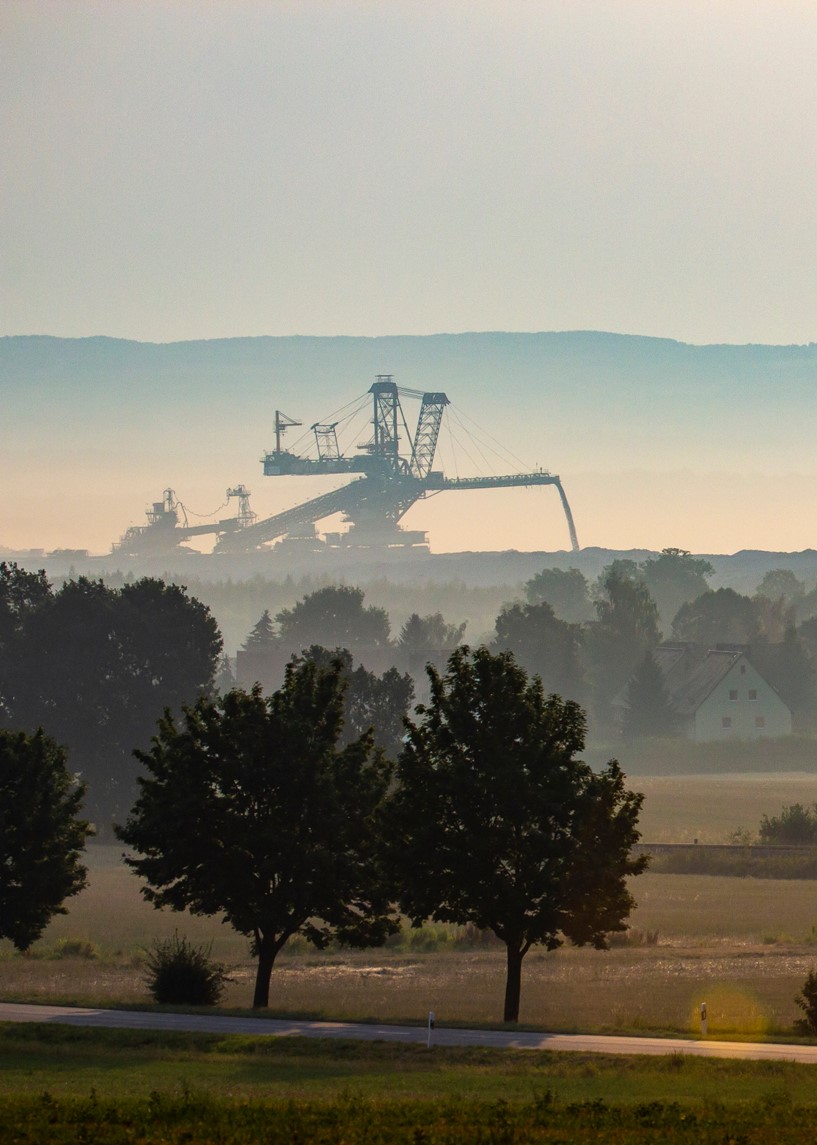
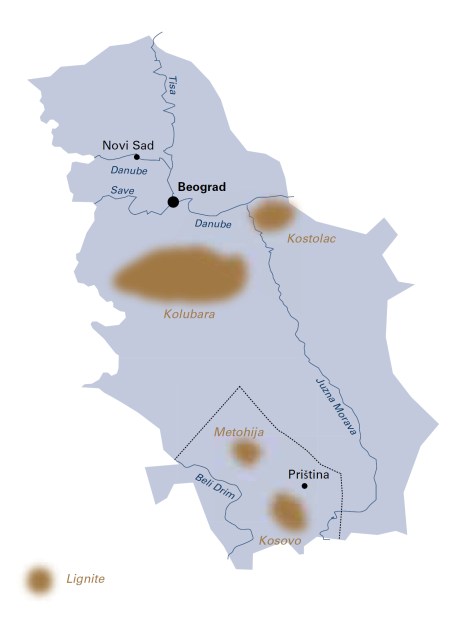
Serbia has very substantial lignite resources which are easily accessible for exploitation. Its lignite reserves are estimated to be 7.1 billion tonnes; in Europe, only Germany and Türkiye have larger reserves. Additionally, there are 13.1 billion tonnes of lignite resources. Deposits are located in two main coal basins, Kolubara and Kostolac. In 2022, Serbia mined 35.1 million tonnes of lignite and imported a further 2.2 million tonnes. Hard coal imports stood at 204 thousand tonnes.
The 100% state-owned ELEKTROPRIVREDA SRBIJE (EPS or Electric Power Industry of Serbia) is a vertically integrated utility company with the EPS Distribution LLC Belgrade subsidiary. EPS has eight divisions for electricity and coal production, including electricity supply which is the company’s main activity. The production, processing and transport of coal, electricity generation, distribution system operator, renewable energy production, and the raising of steam and hot water in cogeneration plants are all performed by EPS. Since June 1999, EPS has not been able to operate its facilities in Kosovo3.
In 2023, the Serbian government transformed EPS into a private joint stock company. For the time being, the state retains a 100% shareholding. With 20 481 employees, excluding workers from Kosovo3, and over 3.4 million consumers, EPS is the largest company in Serbia. The installed capacity of EPS power plants totals 7 391 MW comprising 4 079 MW of lignite-fired power plants, three gas- and oil-fired combined heat and power plants totalling 297 MW (the biggest at Panonske), and 3 015 MW of hydro plants.
Investment in new renewable energy sources is growing. EPS already operates the 158 MW Čibuk 1 and the 104.5 MW Kovačica wind farms, both located near Belgrade and partly financed by the European Bank for Reconstruction and Development. In the Kostolac lignite basin, other projects should complete in 2024: the 66 MW Kostolac wind farm and the 10 MW Petka solar PV park, as well as solar PV panels on the roof of the Nikola Tesla A lignite-fired power plant. Further such 10 MW solar PV projects are planned at Nikola Tesla B and on the ash heaps at Kolubara A and Morava coal power plants.
Lignite
Production of lignite, with an average calorific value of 7 200 kJ/kg, takes places at surface and underground mines in the Kolubara and Kostolac coal basins.
The 600 square kilometre Kolubara coal basin lies in the western part of Šumadija. There, Field B, Field E, Field G, Tamnava-West and Radljevo surface mines account for around 75% of Serbian lignite production. Lignite is supplied by rail to the Kolubara thermal power plant (TPP) at Veliki Crljeni, TPP Nikola Tesla A and B at Obrenovac about 40 kilometres from the mines, and TPP Morava at Svilajnac. Together, these three thermal power plants comprise ten units with a total capacity of 3 166 MW. Lignite from the surface mines is processed in coal preparation plants at Vreoci and the Tamnava-West mine.
 In the Kolubara coal basin, surface mine Field E, with 400 million tonnes of lignite reserves, is progressively being developed as a replacement for Field D. The mine’s planned annual output is 12 million tonnes. Field G surface mine extension was opened in 2017 with 36.5 million tonnes of good quality lignite reserves. In 2019, the new Radljevo surface mine with 350 million tonnes of lignite reserves opened after many months of overburden removal. The relocation of infrastructure to serve these new mines in the Kolubara basin was completed early in 2019.
Lignite mined in the Kostolac basin, from the 50 square kilometre Drmno coal deposit in the eastern part of the basin, accounts for the remaining 25% of Serbian lignite production and is supplied to the 310 MW Kostolac A and 700 MW Kostolac B power plants.
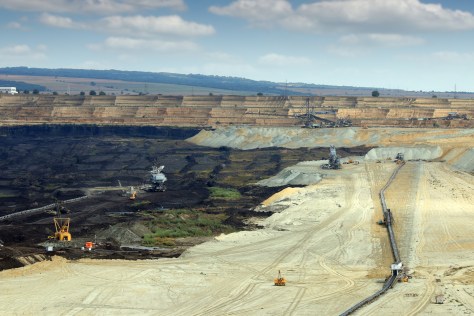
In 2022, EPS extracted 34.6 million tonnes of lignite in the Kolubara and Kostolac basins and removed 106 billion cubic metres of overburden, with overburden-to-production ratios of 2.7 cubic metres per tonne in Kolubara and 4.0 cubic metres per tonne in Kostolac. In addition, EPS purchased coal from underground mines operated by state-owned PEU “RESAVICA” U RESTRUKTURIRANJU, producing up to 500 thousand tonnes per year and employing 3 565 workers as at December 2022.
In December 2014, a loan agreement was signed by the Serbian government with the EXIM BANK OF CHINA to finance a new 350 MW unit B3 at TPP Kostolac and to extend the annual capacity of Drmno mine from 9 million tonnes to 12 million tonnes of lignite. Construction is in progress and the new unit should be operational by September 2023. The new unit will help secure Serbia’s electricity supply while respecting EU environmental law.
When Kostolac B3 comes online, the older units of Kolubara A and Morava will be decommissioned. By 2028, Kostolac A and the oldest two units at Nikola Tesla A should also be decommissioned. By then, a new 300 MW gas-fired power plant is scheduled to be online. Kolubara B should be co-fired with 30% biomass with Nikola Tesla A3-A6 continuing on 100% lignite. EPS has invited tenders for a new 630 MW pumped-storage hydro plant at Bistrica. This €1.2 billion project could partly replace Nikola Tesla A3-A6 sometime after 2031. Until 2025, annual demand for lignite from the Kostolac basin should remain at 7.3 to 8.0 million tonnes. Consumption of lignite from Kolubara is expected to decrease. With this emissions reduction strategy, Serbia should comply with the EU carbon border adjustment mechanism to be phased in from 1 January 2026.
To comply with EU environmental standards, EPS has invested heavily in power plant modernisation and environmental protection projects, particularly at its thermal power plants where flue gas desulphurisation, electrostatic filters, ash and slag transport, and wastewater treatment projects have been completed. By the end of 2025, EPS plans to have invested more than €850 million in its facilities in order to improve efficiency and environmental protection. About €650 million will be invested in air pollution control equipment to further reduce emissions of sulphur dioxide, oxides of nitrogen and fine particulates.
Serbia
|
Coal production, reserves and resources |
2022 |
|
|
Hard coal saleable output |
Mt |
– |
|
Hard coal reserves |
Mt |
402 |
|
Hard coal total resources |
Mt |
855 |
|
Lignite saleable output |
Mt |
35.1 |
|
Lignite reserves |
Mt |
7 112 |
|
Lignite total resources |
Mt |
20 186 |
|
Saleable coal quality |
|
|
|
Hard coal net calorific value |
kJ/kg |
12 000 ‑ 18 000 |
|
Hard coal ash content |
% a.r. |
12.0 ‑ 35.0 |
|
Hard coal moisture content |
% a.r. |
45.0 ‑ 54.0 |
|
Hard coal sulphur content |
% a.r. |
0.9 ‑ 3.8 |
|
Lignite net calorific value |
kJ/kg |
7 200 ‑ 8 200 |
|
Lignite ash content |
% a.r. |
14.0 ‑ 18.0 |
|
Lignite moisture content |
% a.r. |
48.0 ‑ 52.0 |
|
Lignite sulphur content |
% a.r. |
0.4 ‑ 0.9 |
|
Coal imports / (exports) |
|
2022 |
|
Hard coal |
Mt |
0.2 / (0.0) |
|
Lignite |
Mt |
2.2 / (0.0) |
|
Primary energy production |
|
2022 |
|
Total primary energy production * |
Mtce |
15.0 |
|
Lignite production |
Mt / Mtce |
35.1 / 9.1 |
|
Primary energy consumption |
|
2022 |
|
Total primary energy supply * |
Mtce |
23.0 |
|
Hard coal consumption |
Mt / Mtce |
0.2 / 0.2 |
|
Lignite consumption |
Mt / Mtce |
37.1 / 9.6 |
|
Power supply |
|
2022 |
|
Total gross power generation |
TWh |
36.0 |
|
Net power imports (exports) |
TWh |
2.6 |
|
Total power supply |
TWh |
34.9 |
|
Power generation from hard coal |
TWh net |
0.7 |
|
Power generation from lignite |
TWh net |
21.5 |
|
Hard coal power generation capacity |
MW net |
486 |
|
Lignite power generation capacity |
MW net |
5 661 |
|
Employment |
|
2022 |
|
Direct in lignite mining and power generation |
number |
16 700 |
* 2021
 powering transition in Europe