
 Since its foundation in 1991, the Republic of Slovenia has enjoyed steady economic growth. After a period of strong growth from 2014, the economy slowed in 2019. The country’s primary energy consumption grew until 2008 when the trend reversed. In 2022, total primary energy supply was 9.1 million tonnes of coal equivalent.
|
General data |
|
2022 |
|
Population |
million |
2.1 |
|
GDP |
€ billion |
57.0 |
|
Per capita GDP |
€/person |
27 000 |
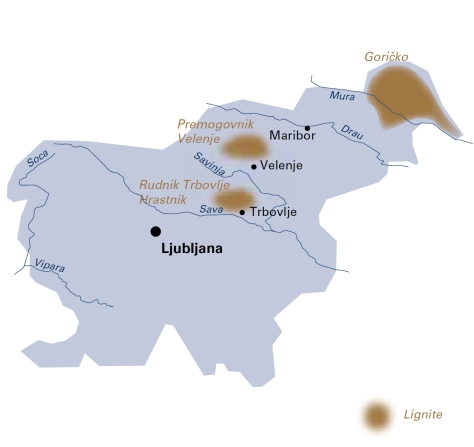
Resources of lignite and brown coal in Slovenia are estimated to be 1 244 million tonnes, lying at Velenje (346 million tonnes), Zasavje (68 million tonnes) and Goričko (830 million tonnes), with mineable reserves accounting for 100 million tonnes of the total resources. In 2022, 52.3% of the country’s primary energy requirements were met by imports. Indigenous lignite production and coal imports accounted for 11.8% of primary energy supply in 2022. Oil had a share of 37.3%, nuclear 22.3%, renewable sources 11.4%, fossil gas 10.4%, hydro 4.1%, waste 0.8% and electricity imports accounted for the remainder.
The key elements of Slovenian energy policy are closely aligned with EU priorities, such as a national plan for renewables and a plan to improve energy efficiency. In the area of climate policy, Slovenia adopted a strategic framework for climate change adaptation in December 2016. In the long term, coal and lignite are expected to be partially replaced by renewable energy sources, fossil gas and biomass. PREMOGOVNIK VELENJE will continue its lignite production until 2033 under current plans as lignite is needed to maintain a well-balanced energy mix for security of supply reasons.
At 41.2% in 2022, nuclear power accounted for the largest share of gross electricity generation in Slovenia, followed by hydro (23.1%) and lignite (23.0%). Other sources had rather small shares, dominated by solar (4.7%). Over 70% of Slovenia’s electricity generation is from zero-carbon sources.
Lignite
Only one lignite deposit is exploited in Slovenia, at Velenje in the north of the country. In 2022, 2.4 million tonnes of lignite were produced. Velenje mine is the only coal mine in Slovenia and all its lignite output is used at the nearby Šoštanj power plant. Operated by PREMOGOVNIK VELENJE and employing a unique mining method, it is one of the largest and most modern underground mines in Europe. The mine is in the Šaleška dolina valley and boasts one of the thickest-known lignite seams in the world, at more than 160 metres.

The company’s long-term strategy is to operate the mine until 2033, as it is likely to remain Slovenia’s only exploited indigenous energy resource. The Velenje coal mine belongs to the state-owned HOLDING SLOVENSKE ELEKTRARNE (HSE) who also owns the 1 029 MW Šoštanj (TEŠ) thermal power plant as well as hydro power plants.
Imported coal is mostly used at ENERGETIKA LJUBLJANA’s Termoelektrarna Toplarna Ljubljana (TE-TOL) heat and power plant in Ljubljana. The company covers over 48% of the capital’s household demand for heat.
Taking into consideration the increasing demand for electricity, the risks of energy import dependence and the abundant coal reserves at Velenje, HSE commissioned a new 600 MW unit at Šoštanj thermal power plant in 2015. Unit 6 uses the best available techniques (BAT) to achieve an efficiency of more than 43% and deliver CO2 emission reductions of 35% as older units are replaced. The new
unit has had a very positive economic and environmental impact in Slovenia by ensuring stable electricity prices and lower emissions.
PREMOGOVNIK VELENJE is a technologically well-developed and strongly integrated company with almost 150 years of operation in lignite mining. In 2007, the company received a special award from the Slovenian Chamber of Engineers for its innovative approach to mining engineering.
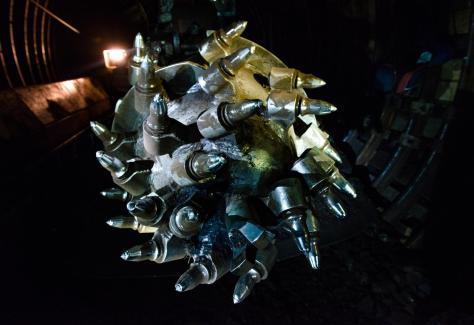
The “Velenje mining method” is performed by top caving hanging seams. The very first long-wall faces appeared in 1947, quickly followed by the extensive introduction of long-wall faces in 1952. The basic approach is to extend the lignite extraction area above the protected area at the face. The “Velenje mining method” has been proven to be the most effective method for extracting thick coal seams. PREMOGOVNIK VELENJE continues to develop this method to improve its productivity even more.
The knowledge and products of PREMOGOVNIK VELENJE offer excellent opportunities for co-operation with other countries, particularly where there is a need to introduce new technologies in Europe (e.g. in Bosnia and Herzegovina, North Macedonia, Montenegro, Serbia and Türkiye).
PREMOGOVNIK VELENJE is also a partner in many EU-funded research and innovation projects which aim to develop clean coal technologies and safer mining solutions, as well as to execute transition projects that aim to repurpose end-of-life underground coal mines to create new green and quality jobs.
PREMOGOVNIK VELENJE has always aimed to prevent and eliminate any negative environmental impacts of its operations and has played an active role in land rehabilitation and air/water protection programmes in the Šaleška dolina valley. The company regularly monitors its environmental impacts, but the clearest testament to sustainable development is the tourist and sports resort that has been developed around the man-made lakes above the Velenje coal mine.
The energy transition brings new challenges in Slovenia and elsewhere. As recognised in the European Green Deal, a just transition should be ensured in those regions affected by structural change brought about by any reductions in coal mining or coal-fired power generation. In January 2022, the Slovenian government adopted a national strategy for phasing out coal and restructuring the coal-intensive regions in accordance with the principles of a just transition. This strategy stipulates that Slovenia will cease using coal for the production of electricity by 2033 at the latest. It is planned to replace coal mainly with renewable energy sources. With that objective in mind, it will be necessary to adopt regulations for the gradual closure and restructuring of Velenje mine in line with a green energy transition and the sustainable economic development of the region.
Slovenia
|
Coal production, reserves and resources |
2022 |
|
|
Lignite saleable output |
Mt |
2.4 |
|
Lignite reserves |
Mt |
100 |
|
Lignite total resources |
Mt |
1 244 |
|
Saleable coal quality |
|
|
|
Lignite net calorific value |
kJ/kg |
10 650 |
|
Lignite ash content |
% a.r. |
16 |
|
Lignite moisture content |
% a.r. |
35 |
|
Lignite sulphur content |
% a.r. |
1.6 |
|
Coal imports / (exports) |
|
2022 |
|
Hard coal |
Mt |
0.4 / (0.0) |
|
Lignite |
Mt |
0.0 / (0.0) |
|
Primary energy production |
|
2022 |
|
Total primary energy production |
Mtce |
4.5 |
|
Lignite production |
Mt / Mtce |
2.4 / 0.9 |
|
Primary energy consumption |
|
2022 |
|
Total primary energy supply |
Mtce |
9.1 |
|
Lignite consumption |
Mt / Mtce |
2.5 / 0.9 |
|
Power supply |
|
2022 |
|
Total gross power generation |
TWh |
13.6 |
|
Net power imports (exports) |
TWh |
1.4 |
|
Total power supply |
TWh |
14.0 |
|
Power generation from lignite |
TWh |
2.8 |
|
Lignite power generation capacity |
MW net |
981 |
|
Employment |
2022 |
|
|
Direct in lignite mining |
number |
1 196 |
|
Other lignite-related * |
number |
2 300 |
* e.g. in power generation, equipment supply, services and R&D
 powering transition in Europe