All posts by euracoal

EURACOAL responds to the Commission’s package of legislative proposals

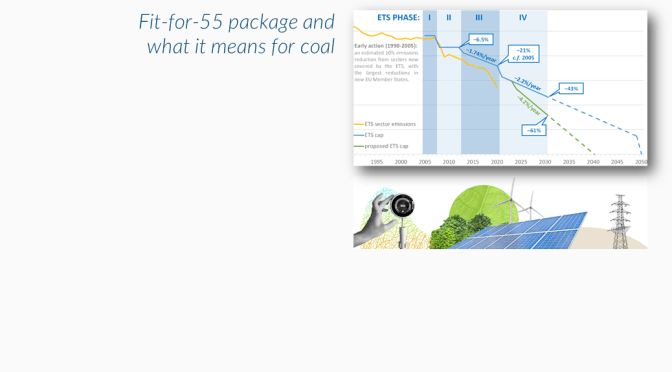
On 14 July 2021, the European Commission adopted a package of proposals to deliver on the targets agreed in the European Climate Law and so revolutionise the economy and society for a fairer, greener and more prosperous future. Known as the “Fit-for-55” package, it aims to make the EU’s climate, energy, land use, transport and taxation policies fit for reducing net greenhouse gas emissions by at least 55% by 2030, compared with 1990 levels. Europe would then be on the way to becoming the world’s first climate-neutral continent by 2050 – making the European Green Deal a reality.

Today, EURACOAL responds to this important package of legislative proposals which will have a dramatic impact on coal production and use across the EU: Continue reading EURACOAL responds to the Commission’s package of legislative proposals

The future of coal regions depends on joint efforts

Mr. Vladimír Budinský, EURACOAL President (right) and Mr. Stanislaw Tillich, German Federal Government Commissioner for Structural Change in the Ukrainian Coal-Mining Regions at the ІV International Coal Conference, Kyiv, 13 July 2021

On 13 July 2021, the ІV International Coal Conference “Coal regions of Ukraine: just transition and coal mining – Ukrainian and international experience” took place at Academy DTEK in Kyiv. More than two hundred experts from Ukraine and EU countries discussed the coal industry transition.  Representatives of the Ukrainian government and large businesses, leaders of trade unions and directors of regional authorities joined thematic sessions on:

  • Achieving carbon neutrality and leveraging opportunities for coal communities
  • Coal mining in the context of the green energy transition, and
  • Just transition for the coal regions – possibilities for economic diversification of mono-towns.

Continue reading The future of coal regions depends on joint efforts

On the order of the Court of Justice to suspend lignite mining at Turów opencast mine

EURACOAL notes the decision taken by the Vice-President of the Court of Justice of the European Union to order, as an interim measure, the suspension of lignite extraction at Turów mine in Poland – a surface mine established in 1904 which today lies close to the Czech and German borders. Continue reading On the order of the Court of Justice to suspend lignite mining at Turów opencast mine

EURACOAL proposes measures to encourage methane capture and use

The EU Methane Strategy, published by the European Commission in October 2020, covers several areas of human activity.

JSW-7

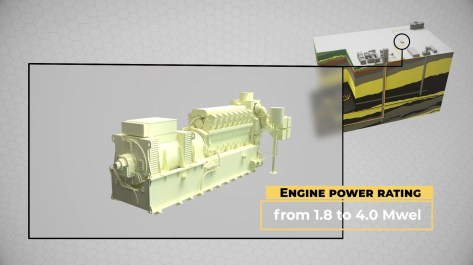
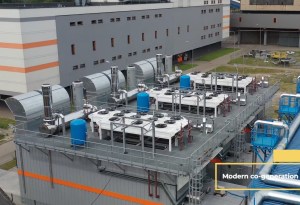
JSW-5-cropFor the energy sector, the focus is on fugitive emissions from oil and gas production, supply infrastructure and end use, rather than from coal mining. In light of the international nature of emissions from EU energy-supply chains, this is the right approach and the strategy should be used as a tool in climate diplomacy. In the case of methane from coal mines, EURACOAL highlights in a new position paper several actions at the EU level that would further encourage the mitigation of this methane, turning an environmental issue into a clean energy resource. Continue reading EURACOAL proposes measures to encourage methane capture and use

On the unintended consequences of the Aarhus Regulation

EURACOAL submitted its position paper with a letter to the European Commission in which we warn against measures that risk slowing new investment in clean technologies. Current proposals to revise the “Aarhus Regulation” would delay transformation of the EU energy sector as interest groups seek to challenge new developments of all types.  Why?  Because every project could be argued to have a climate impact, and any NGO could claim to represent the environment.

EURACOAL supports equal access to justice. However, access should only be granted to those directly affected. Extending justice to all under climate law risks opening a Pandora’s box whereby literally anyone can claim harm caused by others.

Secure planning procedures

To transform the EU energy sector and economy, we need faster investment procedures, not slower ones. EURACOAL has urged the European Commission to begin a process to renegotiate the UNECE Aarhus Convention at the international level, so that a better balance can be found between access to justice and a secure planning framework for clean-tech investments.

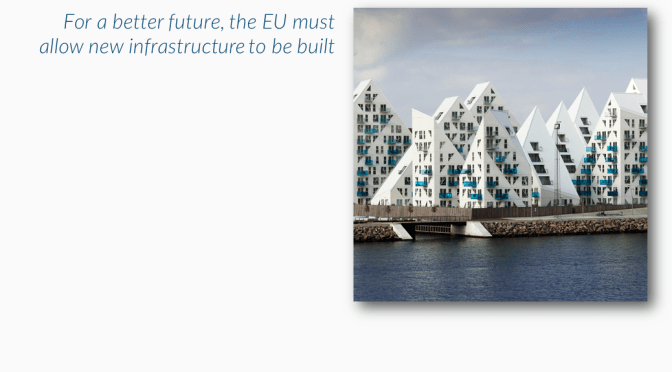
photo: Isbjerget as seen from the high speed ferry Århus-Sjællands Odde on the way out of the harbour in Århus, Denmark (© Slaunger / Wikimedia Commons/ CC-BY-SA-3.0)

Changing the face of coal

The European Commission’s Coal Regions in Transition Platform initiative includes a number of activities of relevance to the research community. EURACOAL has been a partner in the EU-supported CoalTech2051 project which has developed a future coal-related research strategy with input from many stakeholders.

click to download report

This report details the strategy and gives examples of research projects that are already pushing the boundaries to deliver new solutions that can better position coal and the coal regions for the future.

EURACOAL joins Clean Hydrogen Alliance

Imagine an energy system where the electricity that powers our cars came from the solar panels on our roofs, while our buildings are kept warm with heat from a nearby factory, and the factory is fuelled by clean hydrogen produced from offshore wind turbines. With the European Commission’s new hydrogen strategy (COM(2020) 301), this vision of an hydrogen ecosystem can be reality. Continue reading EURACOAL joins Clean Hydrogen Alliance

Crisis in Ukraine

Like every other country, Ukraine is facing a Covid-19 crisis, but with the added complication that its electricity market is failing to deliver.

In March 2020, Ukrainian electricity demand fell by 7%, because of the Covid-19 lockdown. At the same time, power exports to Hungary, Slovakia and Romania surged by over 50% in the first quarter of 2020 from the synchronised Burshtyn region of Ukraine.  This was because wholesale electricity prices outside Ukraine are far more attractive. To protect the country’s heavily indebted energy sector, the government imposed a 65% tariff on coal and electricity imports from Russia on 1 April 2020. Meanwhile, household, commercial and even industrial prices remain regulated with caps, despite an opening-up of the electricity market last year.

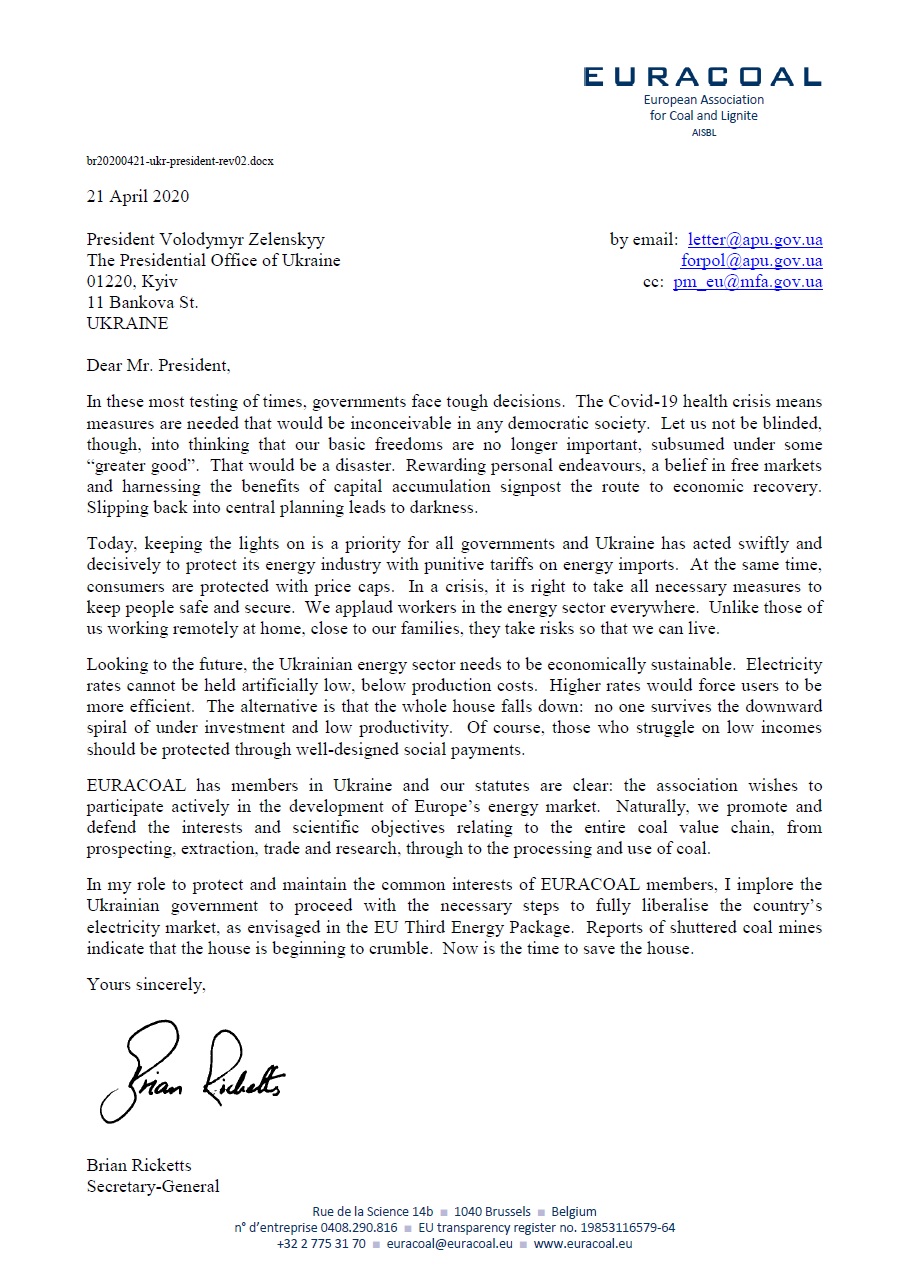
In its letter to President Zelenskyy, EURACOAL looks to the future and asks the Ukrainian government to stick with market-based solutions and electricity market liberalisation, rather than return to a failed system of central planning. As agreed in its Association Agreement with the EU, Ukraine should implement the EU Third Energy Package and did introduce the necessary legislation with a start date of 1 July 2019.

Protectionist measures are not working and Ukraine’s largest energy company, DTEK, has had to idle the big Pavlohradcoal mine. Energy companies, including SOEs, are not receiving enough income to operate. The State Company “Guaranteed Buyer” (responsible for subsidising household tariffs and renewables) has massive debts to the nuclear and renewable power companies (estimated at UAH 8.7 billion or EUR 300 million).

Part of the problem is that cross subsidies and over-generous feed-in tariffs for renewable energy sources have pushed up electricity prices such that huge debts have built up in the energy system. The government has responded by retrospectively reducing feed-in tariffs. A fairer solution would be to introduce an auction system for renewables. Electricity prices caps should be replaced with social support for those on low incomes. The caps mean heavy industry benefits from unfair subsidies. Unfortunately, the government has reduced social support intended to help with utility bills – this will lead to more debt.

Read our letter here.

EURACOAL responds on Just Transition Fund

click to download

A Just Transition Fund is very much needed if the EU, with the agreement of member states and the European Parliament, is to complete the huge transformation to a climate-neutral continent. Under the European Green Deal, many member states need to make great changes to their economies as they are no longer viable under current EU rules for energy systems and the even greater efforts envisaged in light of more ambitious climate targets for 2030. Investments will be required and so the European Association for Coal and Lignite (EURACOAL) welcomes, in principle, the proposals contained in the European Commission’s communication of 14 January 2020 for a Just Transition Fund (COM(2020) 22 final). The promise of linking the new fund to existing Structural Funds as part of a Just Transition Mechanism to lever €30 billion or even €50 billion of investment is especially welcome. In this respect, public consultation on the proposed amendments to the Common Provisions Regulation is perhaps even more important than this consultation on the Just Transition Fund. Continue reading EURACOAL responds on Just Transition Fund

MEPs preview latest EURACOAL publication

European Parliament, Brussels, 28 January 2020

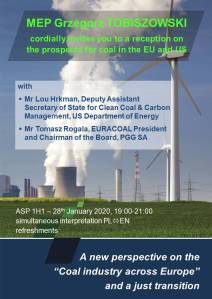
MEP Grzegorz Tobiszowski hosted an evening event dedicated to the coal industry in transition, bringing together eight fellow MEPs with members of the European Association for Coal and Lignite, prior to the launch of EURACOAL’s latest publication.
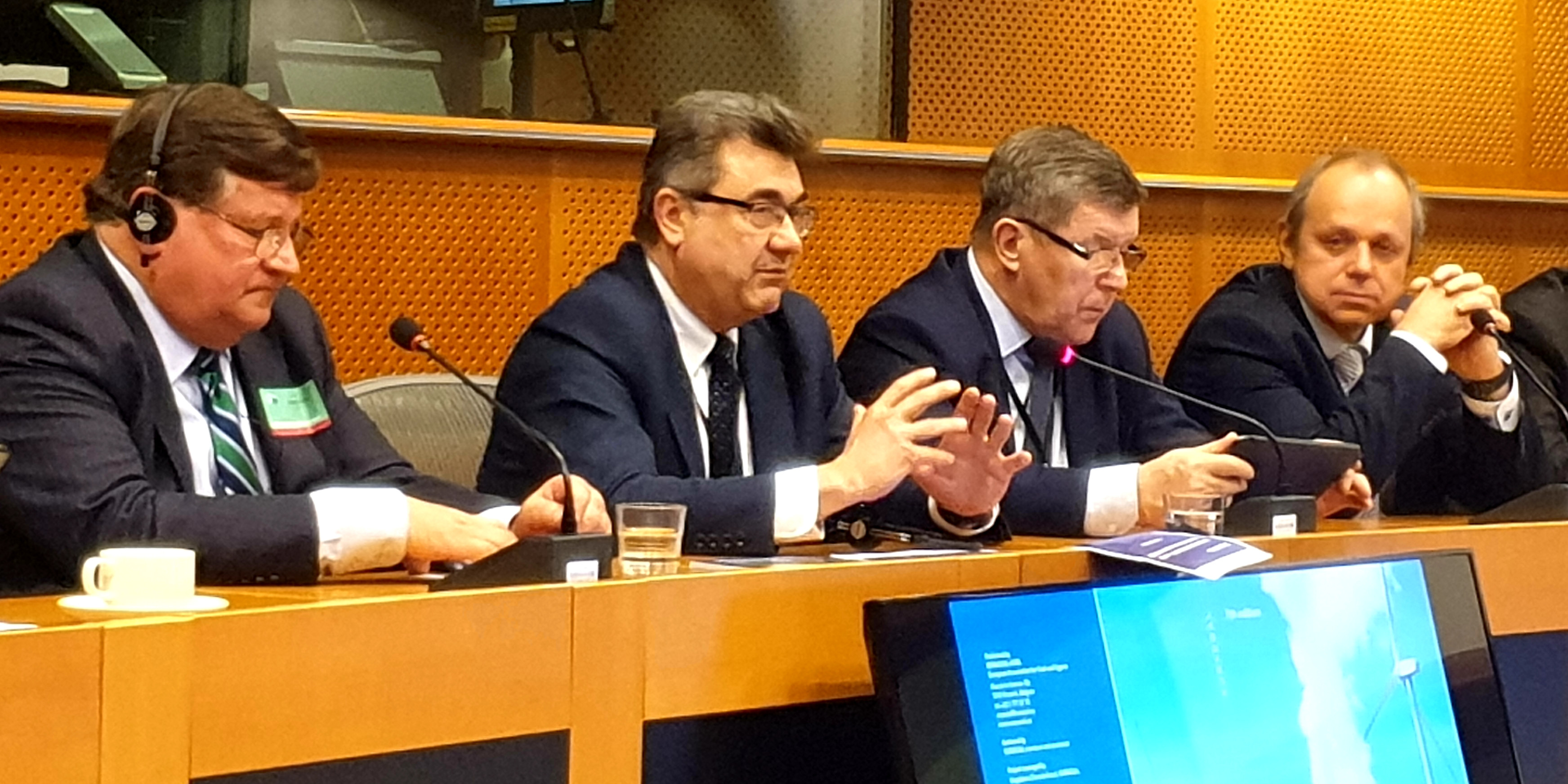
Invited guest, Mr. Lou Hrkman who is the Deputy Assistant Secretary at the US Department of Energy, spoke about his government’s approach to coal, after remarking that, “the US has no greater friends than Poland and the EU”. The current US administration supports innovations that will reduce GHG emissions from coal to zero, he said, while improving the efficiency and reducing the costs of power plants. He offered the new Allam cycle as an example of a power plant with zero emissions – it supplies pure CO2 to the oil industry and even produces water, he added. Work on smaller, modular power plants will lead to cheaper units that many coal-using countries can rely on to supply heat and power while meeting their Paris Agreement commitments. He wished the EU well with its “just transition”, but said that this was diametrically opposite to the US approach, with its focus on preserving jobs and using fossil fuels in a positive way to enhance economic growth and security. He cited the US oil and shale gas boom which had allowed the US to become energy self-sufficient. For coal, he predicted the 21st century would bring new opportunities, with products made from coal, such as new construction materials and hydrogen for transport. He concluded that, “technology and innovation by the private sector is much better than heavy regulation and taxes”.

(L-R) Mr. Lou Hrkman, Deputy Assistant Secretary for Clean Coal and Carbon Management, US Department of Energy; MEP Grzegorz Tobiszowski; MEP Zbigniew Kuźmiuk; Mr. Vladimír Budinský, First Vice President of EURACOAL

Continue reading MEPs preview latest EURACOAL publication

EURACOAL members in Warsaw for high-level summit

Energy Summit 2019 on “the conditions for a sustainable energy transition” took place in Warsaw on 1-2 October 2019, organised by the Polish Ministry of Energy, EURACOAL and the Polish Mining Group (PGG). Coal industry leaders from across Europe participated to discuss topics of importance. The summit was opened by Mr. Tomasz Rogala, President of EURACOAL and Chairman of the Board at PGG – the biggest hard-coal producer in Europe.

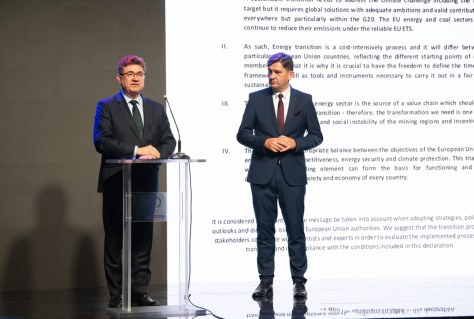
Mr. Tomasz Rogala, President of EURACOAL and Chairman of the Board at PGG, presents MEP Grzegorz Tobiszowski with the Energy Summit 2019 declaration in Warsaw on 2 October 2019.

Continue reading EURACOAL members in Warsaw for high-level summit

EURACOAL Position Paper on “A Clean Planet for All”

Key Points
  • The climate challenge requires global solutions with similar ambitions everywhere.
  • A carbon-neutral EU economy by 2050 is highly ambitious: the necessary technologies need to be developed and deployed, and carbon-leakage risks need to be clearly addressed.
  • Without large-scale energy storage, conventional thermal power generation will still be needed.
  • To gain public support and to maintain EU competitiveness, solutions have to be affordable.
  • EU member states should remain free to choose their own (different) energy mixes.

Continue reading EURACOAL Position Paper on “A Clean Planet for All”